
International Expansion
The World Is Not Your Limit.
International expansion connects businesses to global capital flows, emerging economic opportunities and international value chains. It creates new possibilities for cross-border investment, commercial partnerships and revenue diversification while reshaping how companies compete, operate and generate value across global markets.
The Architecture of Global Economic Integration
The international economy operates through an interconnected system of trade, investment, financial institutions and global production networks. These relationships influence capital allocation, industrial development and the distribution of economic activity among major commercial regions.
Foreign direct investment, bilateral trade agreements and regional economic integration influence the movement of goods, services, technology and financial resources. They also shape the conditions under which businesses establish operations and participate in international commerce.
Global value chains connect manufacturing, logistics, distribution and specialized services across multiple economies. Their structure influences production costs, access to resources, technological capabilities and the efficiency of commercial operations.
Exchange rate volatility, monetary policy, international taxation and geopolitical developments affect investment returns, financing conditions and operating costs. Evaluating these factors is essential to understanding the financial implications of entering different economic environments.
International business development also involves corporate governance, institutional relationships, capital allocation and organizational coordination. The ability to integrate these elements determines how effectively companies can establish a sustainable commercial presence across multiple jurisdictions.
The Human Dimension of Global Business
Different Cultures. Shared Values. Collective Progress.
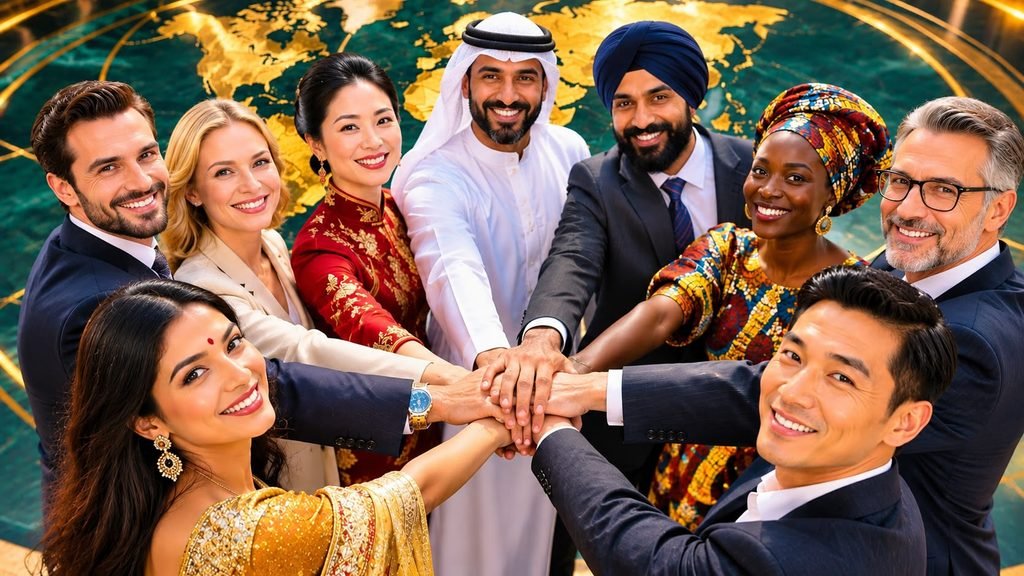
International business is not defined solely by economic opportunities, financial investments or access to new markets. At its foundation, it is built upon people, cultural intelligence, mutual understanding and the ability to establish meaningful relationships across diverse societies.
Every nation brings its own traditions, values, communication styles, business practices and perspectives on leadership. Understanding these differences is essential to building trust, negotiating effectively and developing relationships that extend beyond individual transactions.
Cultural diversity represents one of the most valuable assets of the global business environment. When different perspectives, experiences and capabilities come together, they create opportunities for innovation, stronger partnerships and more informed decision-making.
Successful international collaboration requires respect for local identities while recognizing the importance of shared professional principles: integrity, accountability, transparency and mutual commitment.
The strongest international business relationships are not built on the expectation that every culture should think or operate in the same way. They are built on the ability to recognize differences, appreciate individual strengths and transform diversity into collective economic value.
Sustainable global progress emerges when businesses create opportunities not only for themselves but also for the people, partners and communities that contribute to their success.
Different cultures do not need to become identical to move forward together. They need a common purpose, mutual respect and the willingness to build something greater than individual achievement.