
Business Strategy

The Art of Strategic Foresight
The greatest strategic advantage is not found in moving faster, but in seeing further.
At the highest level of business, perspective becomes a competitive asset. Much like an eagle commanding the skies, exceptional strategists develop the ability to observe entire markets, recognize patterns invisible from the ground and identify opportunities long before they become apparent to others.
While competitors remain focused on immediate challenges, visionary leaders examine the forces shaping tomorrow’s commercial landscape. They understand that market movements, consumer behavior, competitive dynamics and economic shifts are not isolated events, but interconnected signals that reveal where industries are heading.
This elevated perspective demands more than experience. It requires analytical discipline, commercial intelligence, sound judgment and the ability to distinguish temporary market noise from fundamental change.
Because the true measure of strategic leadership is not simply how far an organization can advance, but how accurately its leaders can determine where it should go next.
The Intelligence of Strategic Timing
At the highest levels of strategic leadership, time is not simply a resource to be managed. It is a critical dimension of competitive advantage. The most accomplished business leaders recognize that even an exceptional strategy can fail when executed at the wrong moment, while a precisely timed decision can fundamentally reshape an organization’s market position.

Strategic timing requires the ability to interpret economic cycles, anticipate shifts in market demand, assess competitive readiness and identify the moments when opportunity and organizational capability converge. It is the discipline of understanding not only where markets are heading, but when their underlying conditions are approaching a decisive turning point.
The distinction between reactive management and exceptional strategic leadership often lies in the mastery of timing. Visionary executives understand when to accelerate expansion, when to allocate capital, when to reposition a business and when restraint creates greater long-term value than immediate action.
This level of judgment cannot be reduced to speed or intuition alone. It emerges from rigorous analysis, commercial intelligence, scenario evaluation and a sophisticated understanding of the relationship between risk, opportunity and execution.
Because in the architecture of exceptional business strategy, success is determined not only by the quality of the decisions made, but by the precision of the moment in which those decisions are executed.
At the executive level, the difference between ambition and achievement lies in the architecture of decision-making. Organizations operating in competitive international markets require more than clearly defined objectives. They require an integrated framework through which commercial intelligence, capital allocation, leadership priorities and operational execution function as interconnected elements of business performance.
Within this framework, time becomes an instrument of organizational precision. Each phase of executive activity must serve a defined commercial purpose, ensuring that strategic priorities are translated into coordinated decisions rather than fragmented initiatives.
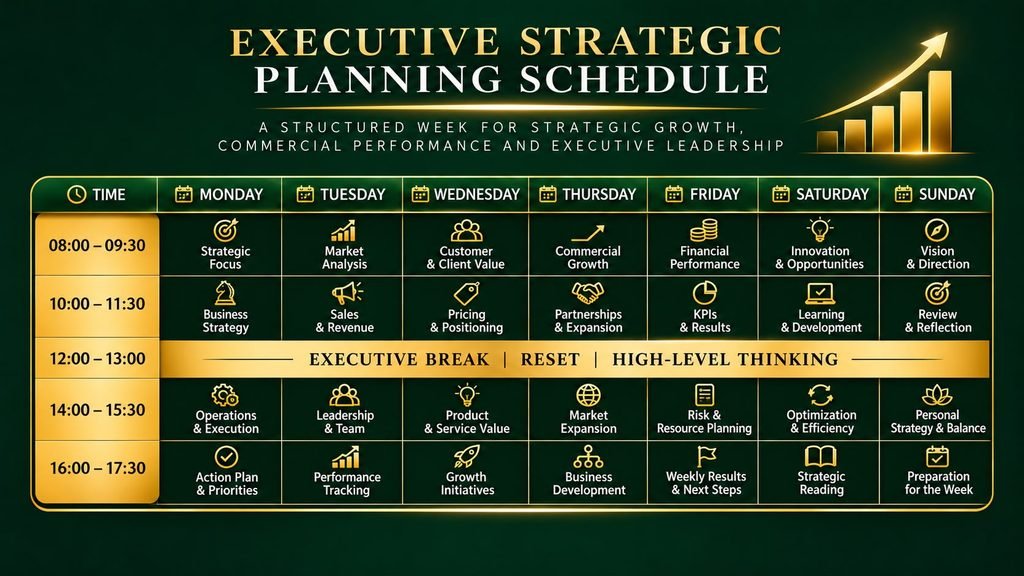
The true value of executive planning lies in the relationships it establishes between analysis, execution and accountability. Market opportunities must be evaluated against financial capacity, growth initiatives must be supported by operational readiness and leadership decisions must remain aligned with the organization’s broader commercial direction.
This approach enables businesses to maintain coherence across competing priorities while preserving the flexibility required to respond to changing market conditions. It creates an environment in which resources are deployed deliberately, performance is assessed continuously and executive attention remains focused on decisions with the greatest long-term commercial significance.
Ultimately, the sophistication of an organization is reflected not in the complexity of its plans, but in the consistency with which its decisions produce measurable business outcomes.